Information ≠ outcome. Students aren’t stuck for lack of a roadmap — they’re stuck for lack of the internal engine to drive the car.
A search engine hands you data; people need a mirror. Occupational identity — the collection of mindsets that decides whether a student actually uses the tools you give them — is that mirror. It rests on three measurable pillars, and everything downstream is an attempt to build them.
Four crises keep students stuck.
Occupational identity is the internal barrier — but it sits inside a broken ecosystem. The research isolates four distinct failure modes.
The Fog of Unawareness
Students have information (via Google) but lack the occupational identity to process it. Without that internal OS, advice never becomes action.
The Broken Bridge
A gulf between academic learning and the labour market. Graduates hold degrees but lack the specific readiness to be employable.
The Pressure Cooker
Career-influencer feeds offer dopamine, not direction — a false sense of progress with no “first useful output,” ending in paralysis.
The Empty Chair
Expert guidance is a luxury good. A 1:10,000 ratio and ₹1.5k–15k sessions leave most students navigating the biggest decision of their lives alone.
Four learners, on two axes.
User interviews resolved onto two axes — how well a student can articulate, and how well they know themselves. The product must detect which quadrant someone is in and change its tone, pacing and tools to match.
“I like many things; I don’t know what’s right.”
“I know my direction — help me refine it.”
“I don’t know what I’m good at.”
“I know what fits me — I just can’t say it well.”
Occupational identity → the 4Cs.
Three psychological pillars map cleanly onto the readiness skills of Career Construction Theory — the “4Cs.” Each pillar is a question; each answer is a muscle we can train.
Confidence · Curiosity · Control · Concern — the four readiness muscles.
A “Career Readiness Gym,” not a chatbot.
Not a search tool (like Google), nor a scarce human counsellor — a Third Space: a low-stakes, high-empathy zone for identity construction. The shift is from information retrieval to identity construction, and every interaction runs one loop:
The Strategist
You already know the direction — I sharpen it. Sharp and efficient: résumé translation, portfolio polish, the fastest path to a tangible win.
The Guide
You like many things — let’s find the fit. Curious and assessment-led: trade-off engines, reality-filtered shortlists, safe career “try-ons.”
The Interpreter
You know what fits — I help you say it. Reflective: the Reflector (“the Voice”) tool gives words to the clarity you already hold.
The Ally
You feel lost — let’s steady you first. Calm and empathy-led: regulate the emotion, then break the mountain into conquerable molehills.
Connection before correction.
The engine doesn’t treat a query as a transaction to solve — it treats it as an emotional signal to metabolise. It begins at the trigger; from there, five steps — each grounded in a specific school of psychology — carry a student from a raw feeling to a built competency. Tap a step.
It all starts here — a panic, a vague “I’m stuck,” or a clear goal. The agentic loop reads this raw input before doing anything else.
Before anything else, the Sentiment Analyser reads the trigger into energy × sentiment — four states — and captures intent, then anchors with the Rogersian move that lowers the affective filter.
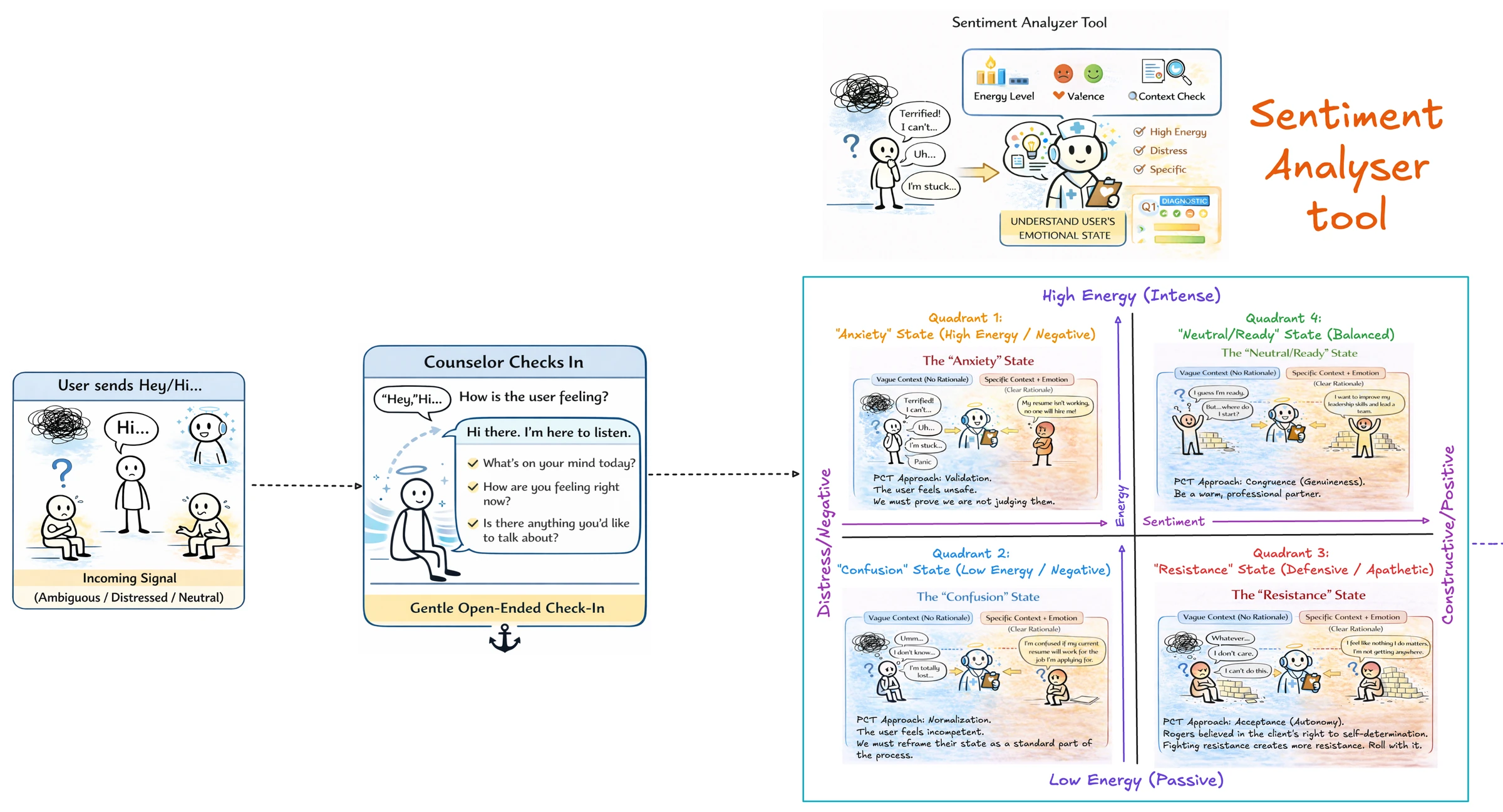
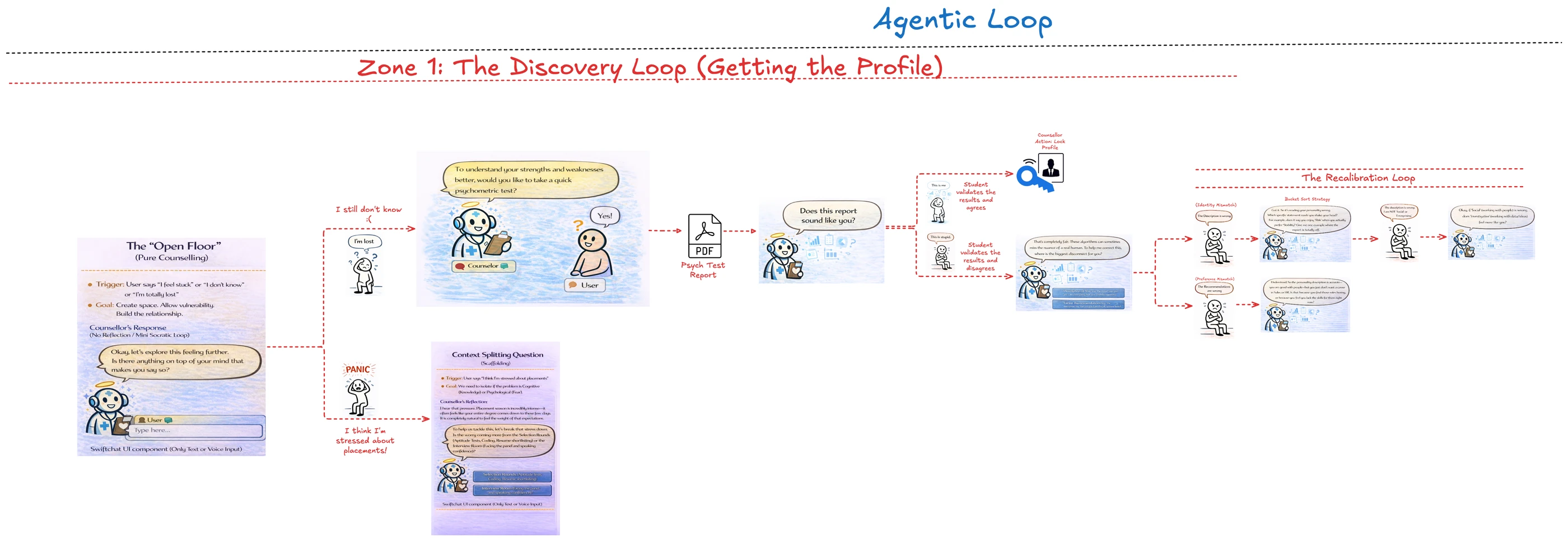
Once the signal is read and intent is captured, the agentic loop routes into the Discovery Loop — which has two zones. Zone 1 is a psychometric assessment that builds a validated profile, for students still working out who they are. Zone 2 is intent capture, the destination for everyone. Arrive already knowing the goal and it’s direct intent — no assessment required.
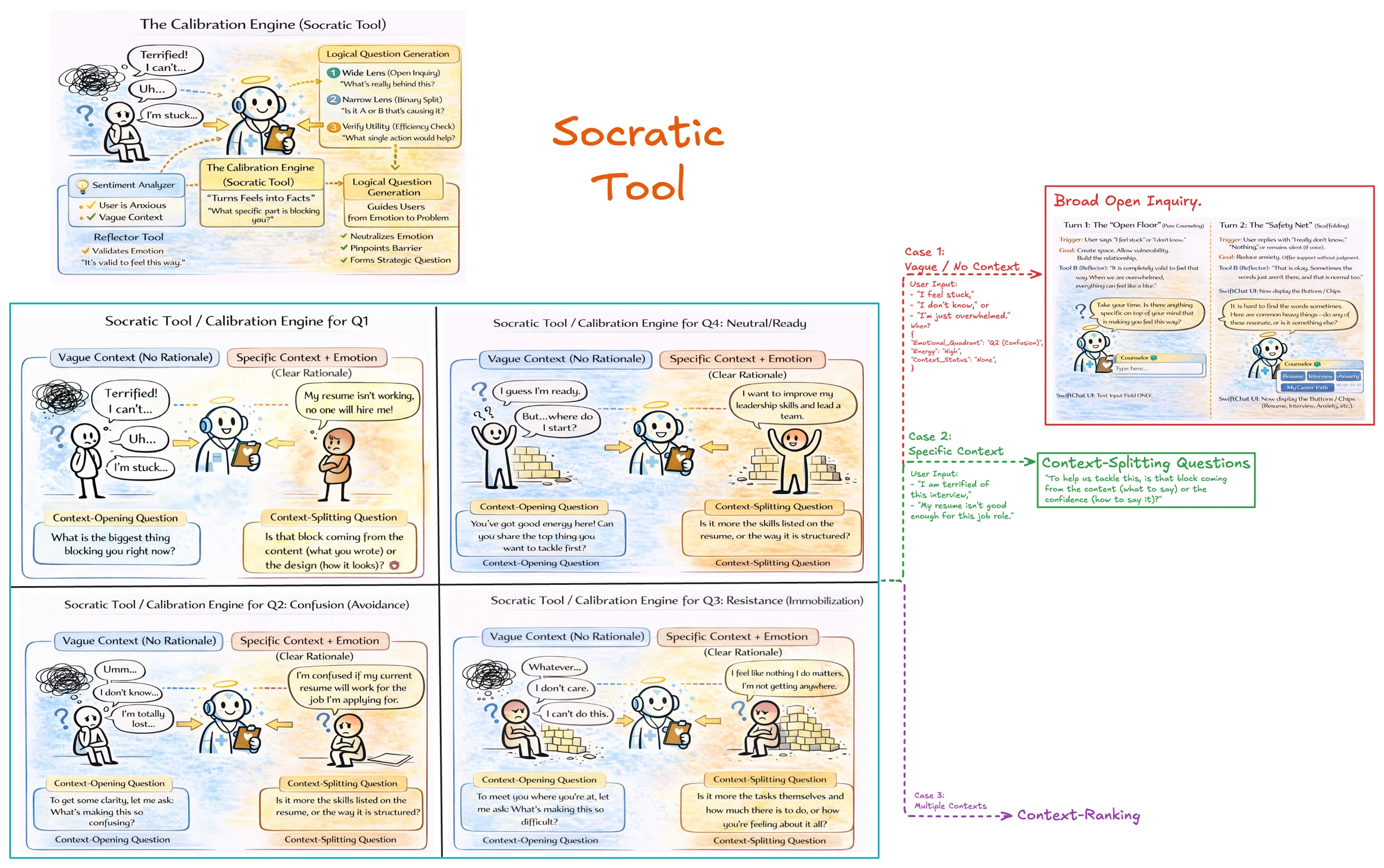
Underneath, one adaptive Socratic question per state — grounded in Beck’s collaborative empiricism — turns a feeling into a fact the student can own.
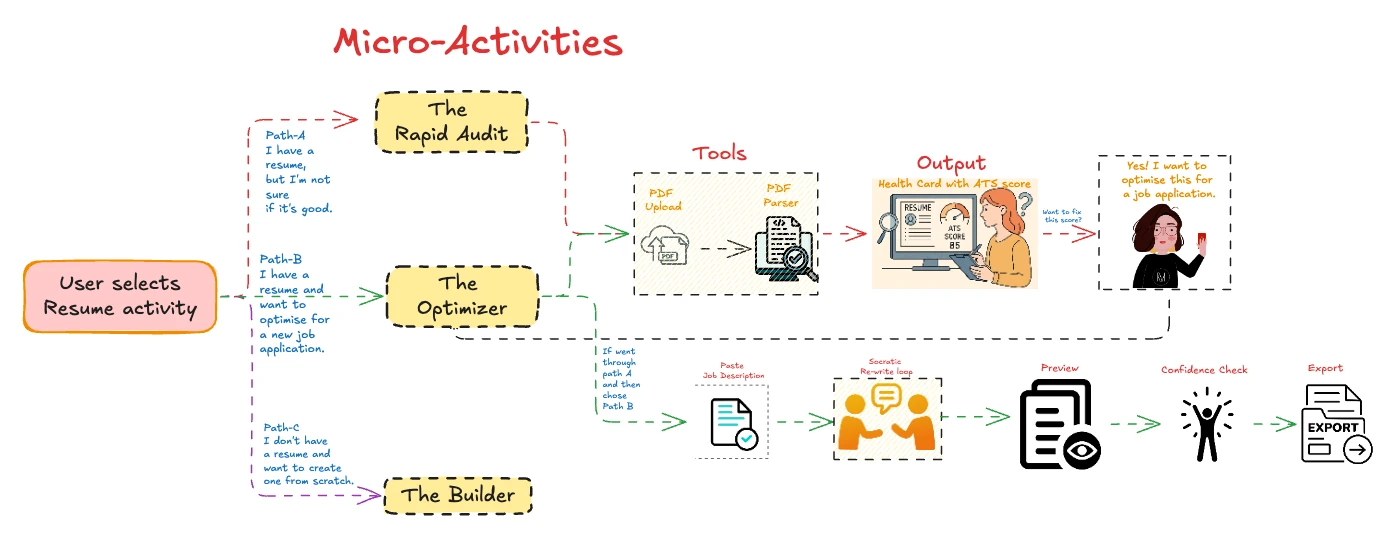
The prescription is never advice — it’s a finite task. One example: the résumé workout.
A profile that fills as you talk.
A psychometric test is only the hypothesis; the conversation is the validation. So the backend keeps a living profile — tracking not just what it knows, but how sure it is. It fills across six buckets, updating in real time as the user talks and the assessment lands.
Academic baseline
Degree & specialisation, year, institution tier, performance — the hard boundary conditions for any advice.
Psychometric engine
The raw RIASEC + Big Five and a core-profile ID — then adjusted live: the test says “introvert,” the chat reveals a 50-person fest they led → Leadership: high.
Reality & constraints
Financial runway, geographic mobility, family pressure, time urgency — so the AI never tells a broke student to study abroad.
Intent & ambition
Stated vs. validated intent, the biases to correct with CBT, and risk tolerance. “VC” was a buzzword; they actually want PM.
Assets & proof-of-work
Claimed skills vs. validated assets. “Good at Python” is weak; a GitHub scraper backs it to a 90% confidence.
Session state & memory
Which loop we’re in, the Socratic questions still pending, and the user’s live tone — so the AI knows how to steer next.
Students state aspirations for prestige or on a whim (“I want to be a VC because it sounds cool”). Build an 18-month roadmap on that and the product fails. So before it commits, the agent scores its own confidence (0–100) as a weighted sum of four layers — and its next move changes with the band.
// drag the score — watch the agent’s move change
Aligns with their degree or psychometrics, but lacks proof.
Standing on real theory.
The design rests on established career and clinical psychology rather than a hunch — combined into an integrative approach: relationship-building, cognitive restructuring, and action planning.
Instruments & frameworks: RIASEC · Big Five (OCEAN) · NACE’s 8 career-readiness competencies · CAAS 4Cs.
The research became a product.
This work is the backbone of an AI career counsellor — one that guides Socratically instead of spoon-feeding, so students build the confidence rather than just collect the answer.